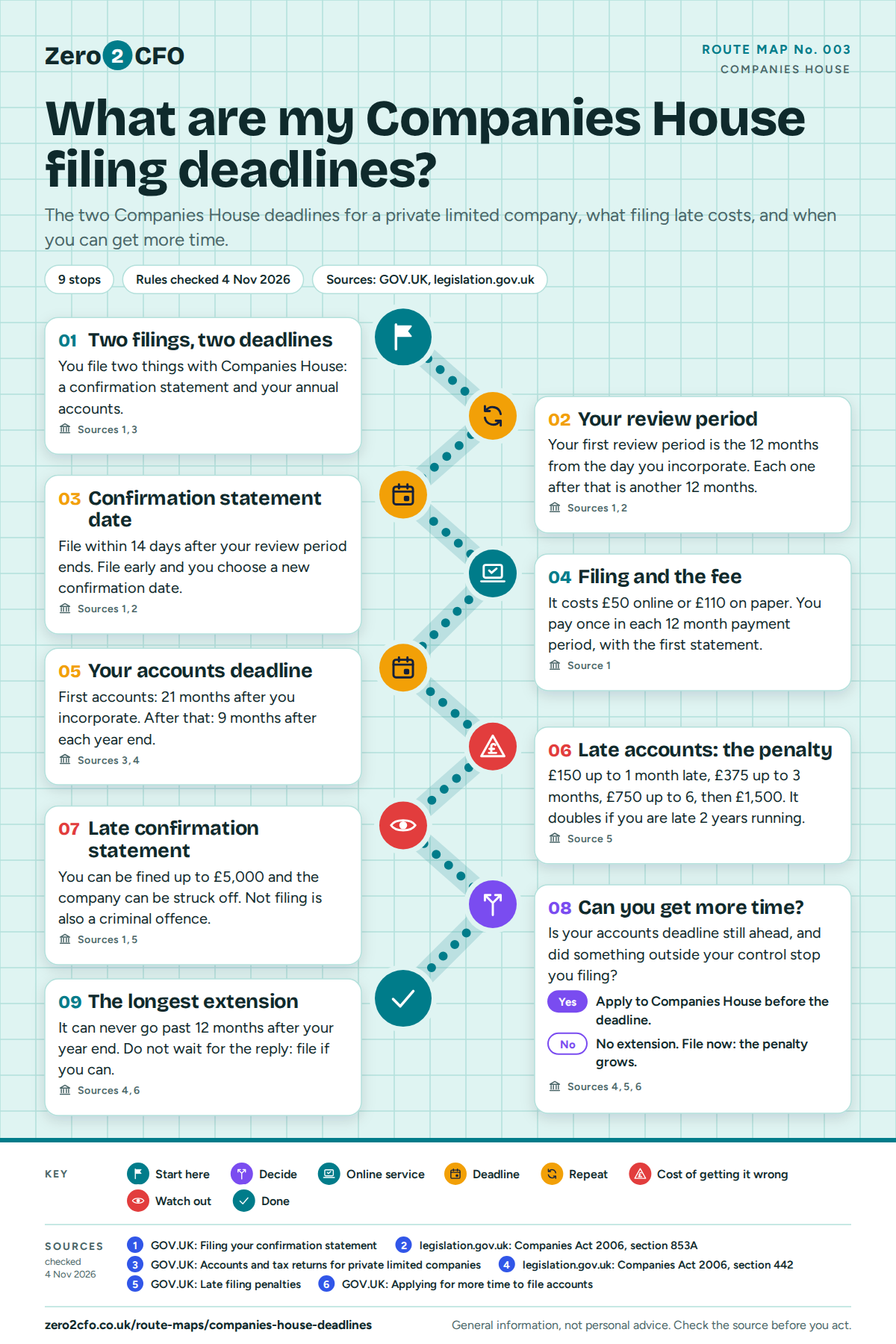
Every private limited company has two deadlines with Companies House. One is the confirmation statement, at least once every 12 months. The other is your annual accounts. First accounts are due 21 months after you incorporate. After that, they are due 9 months after your year end. Miss them and you pay a penalty. This page is general information, not tax advice.
The route, stop by stop
The confirmation statement
You must file at least one confirmation statement every 12 months. You file it even if nothing has changed, and even if the company is dormant.
Your first review period is the 12 months from the day you incorporate. After that, each review period is another 12 months. You then have 14 days after the review period ends to file.
You do not have to wait. If you file early, you choose a new confirmation date, and your next review period starts the day after it.
All directors must have verified their identity before Companies House will accept the statement.
What it costs
It costs £50 to file online and £110 on paper. You pay once in each 12 month payment period, with the first statement you file in it. File again in the same period and you do not pay again. Your payment period is separate from your review period, and you cannot change it.
Your annual accounts
Your first accounts are due 21 months after you incorporate. If your first period is more than 12 months, the law gives you 9 months from the first anniversary of incorporation, or 3 months after the end of that period, whichever is later.
After that, your accounts are due 9 months after your year end. For a 30 September year end, that is 30 June the next year. The deadline still stands if it falls on a Sunday or a bank holiday.
HMRC has its own dates for your Corporation Tax. This map covers Companies House only.
What filing late costs
If your accounts are late, the penalty is automatic. For a private company it depends on how late they are:
- Up to 1 month late: £150.
- More than 1 month and up to 3 months: £375.
- More than 3 months and up to 6 months: £750.
- More than 6 months: £1,500.
If you are late 2 years in a row, the penalty doubles.
For a late confirmation statement, you can be fined up to £5,000 and the company can be struck off the register. Not filing accounts or a confirmation statement is also a criminal offence, so directors can be fined personally.
Can you get more time?
You can ask for more time on your accounts if something outside your control stops you filing. A fire that destroys your records is the usual example. You must apply before your deadline. Companies House only agrees where the reasons are exceptional.
You may not be able to if you have already had an extension. An extension can never take you past 12 months after your year end. Do not wait for the answer. If you can file, file.
The GOV.UK pages on extensions are about accounts. They do not describe an extension for a confirmation statement.
Common questions
Do I file a confirmation statement if nothing has changed?
Yes. You file it every 12 months even if nothing has changed. That includes dormant companies.
When are my first accounts due?
21 months after you incorporate.
When are my accounts due after that?
9 months after your year end.
What happens if I file late?
Companies House sends a penalty notice to the registered office. It is £150 if you are up to 1 month late, and it goes up the later you are.
Can I appeal a late filing penalty?
You can, but it only works if the circumstances were exceptional. Being unfamiliar with the rules, or relying on your accountant, is not enough.
Is this tax advice?
No. It is general information from official pages checked on 4 November 2026. Rules and fees change, so check the sources before you act.
Sources
- GOV.UK: Filing your confirmation statement checked 4 November 2026
- legislation.gov.uk: Companies Act 2006, section 853A checked 4 November 2026
- GOV.UK: Accounts and tax returns for private limited companies checked 4 November 2026
- legislation.gov.uk: Companies Act 2006, section 442 checked 4 November 2026
- GOV.UK: Late filing penalties checked 4 November 2026
- GOV.UK: Applying for more time to file accounts checked 4 November 2026
This Route Map is general information for UK small businesses, not personal advice. Rules and rates change, so check the sources before you act. If your situation is not straightforward, speak to your accountant.